2030 World Cup Stadiums and Host Cities — Complete Guide
Updated: 2026-09-04
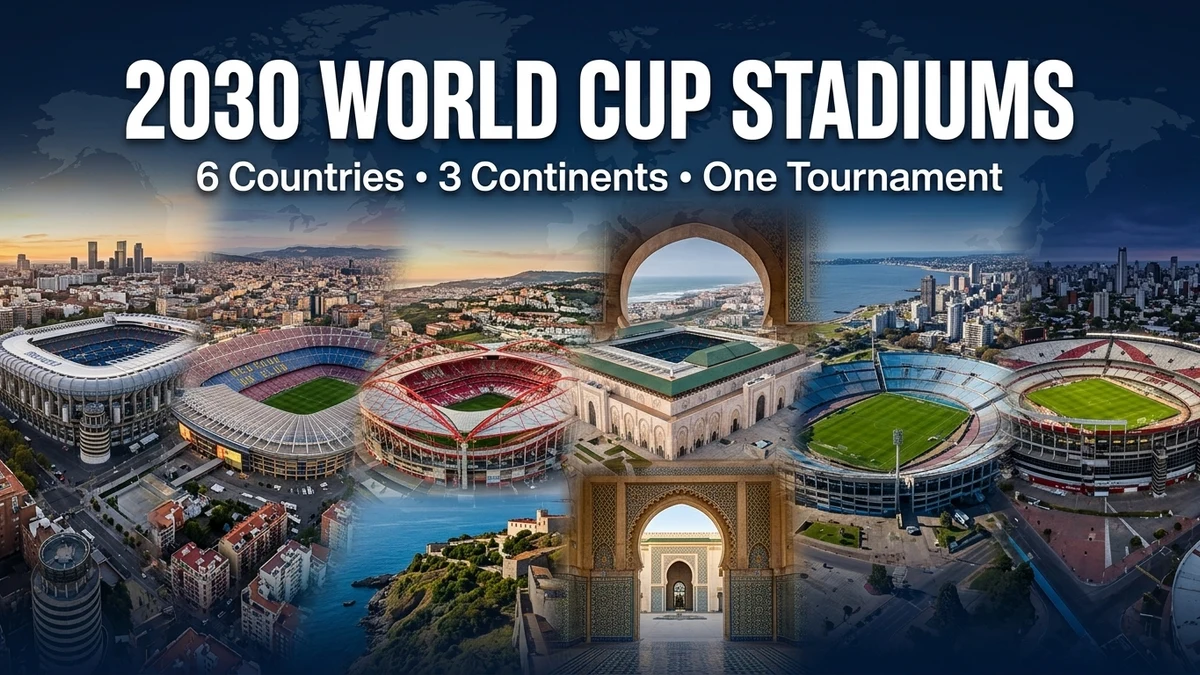
The 2030 World Cup will be unlike any tournament FIFA has staged before.
Morocco, Portugal and Spain will serve as the primary hosts, while Argentina, Paraguay and Uruguay will each stage one special centenary match in South America to mark 100 years since the first World Cup was played in Uruguay in 1930. FIFA formally appointed the six countries in December 2024.
That means World Cup matches are set to span six countries and three continents.
The stadium picture is more complicated.
Morocco has six 2030 stadiums in its official host plan. Portugal has three. Spain originally submitted 11, but Málaga and A Coruña have since withdrawn. The Spanish federation now wants Valencia and Vigo to take their places, with FIFA's final approval of those replacements still pending as of September 2026.
And across the Atlantic, Montevideo, Buenos Aires and Asunción are preparing for one centenary match apiece.
Here's where the 2030 World Cup is expected to be played — and what is still unresolved.
2030 World Cup Stadiums at a Glance
| Stadium | City / Area | Country | 2030 Capacity* | Status |
|---|---|---|---|---|
| Grand Stade Hassan II | Benslimane / Casablanca | Morocco | 115,000 | Under construction |
| Spotify Camp Nou | Barcelona | Spain | ~105,000 | Redevelopment |
| Estadio Monumental | Buenos Aires | Argentina | ~101,000 planned | Centenary venue / expansion |
| Santiago Bernabéu | Madrid | Spain | ~83,000 | Operating |
| Grand Stade de Tanger | Tangier | Morocco | 75,600 | Upgrade/expansion |
| Metropolitano | Madrid | Spain | ~70,700 | Operating |
| Nou Mestalla | Valencia | Spain | 70,044 | Proposed replacement; pending FIFA |
| La Cartuja | Seville | Spain | ~70,000 | Operating/upgraded |
| Prince Moulay Abdellah Stadium | Rabat | Morocco | 68,700 | Rebuilt |
| Estádio da Luz | Lisbon | Portugal | ~65,600+ | Operating / planned upgrades |
| Estadio Centenario | Montevideo | Uruguay | ~60,000+ after planned work | Centenary venue |
| Fez Stadium | Fez | Morocco | 55,800 | Upgrade |
| San Mamés | Bilbao | Spain | ~53,300 | Operating |
| Estádio José Alvalade | Lisbon | Portugal | ~50,100 | Operating / planned upgrades |
| Estádio do Dragão | Porto | Portugal | ~50,000 | Operating / planned upgrades |
| Grand Stade d'Agadir | Agadir | Morocco | 46,000 | Upgrade |
| Estadio Osvaldo Domínguez Dibb | Asunción | Paraguay | ~46,000 planned | Centenary venue / reconstruction |
| Grand Stade de Marrakech | Marrakech | Morocco | 45,860 | Upgrade |
| Balaídos | Vigo | Spain | ~43,000 planned | Proposed replacement; pending FIFA |
| Nueva Romareda | Zaragoza | Spain | ~43,000 | New/redeveloped stadium |
| Reale Arena / Anoeta | San Sebastián | Spain | ~42,300 | Operating |
| RCDE Stadium | Barcelona area | Spain | ~40,500 | Operating |
| Estadio Gran Canaria | Las Palmas | Spain | Expansion required | 2030 venue |
*Capacities are current or planned gross capacities and can change before 2030. FIFA's tournament-use capacity may be lower because seats are allocated to media, hospitality, security and other operational functions.
Two names in that table require an asterisk of their own: Valencia and Vigo are Spain's proposed replacements for Málaga and A Coruña. FIFA has not yet given the final approval that would make those substitutions definitive.
Spain's 2030 World Cup Stadiums: The Largest Share of the Tournament
Spain was originally allocated 11 stadiums in the joint bid, more than Morocco or Portugal.
The initial Spanish list announced by the Royal Spanish Football Federation included Madrid, Barcelona, Bilbao, San Sebastián, Zaragoza, Seville, Las Palmas, Málaga and A Coruña.
That list has changed.
Málaga withdrew La Rosaleda from the project in 2025, and A Coruña later abandoned its plans to use Riazor. The RFEF says it wants to preserve Spain's total of 11 venues by replacing them with Nou Mestalla in Valencia and Balaídos in Vigo. Federation president Rafael Louzán said in July 2026 that both alternatives were prepared and that FIFA would return to Spain after September to evaluate progress.
So Spain's current 2030 picture looks like this.
Santiago Bernabéu — Madrid
Capacity: approximately 83,000
The Bernabéu is the most established of Spain's potential showpiece venues.
Real Madrid's stadium has undergone an enormous modernization that added a retractable roof, retractable pitch and extensive hospitality and event infrastructure.
It also has history FIFA cannot recreate anywhere else in the Spanish bid: the Bernabéu hosted the 1982 World Cup final, when Italy defeated West Germany.
Today, it is one of the leading venues being discussed for the 2030 final, although FIFA has not selected the final stadium. Reuters reported in July that Madrid, Barcelona and Morocco's new Hassan II stadium are at the center of the competition for the match.
Metropolitano — Madrid
Capacity: approximately 70,700
Atlético Madrid's Metropolitano gives the Spanish capital two major World Cup venues.
Opened in its current form in 2017, the stadium has already staged a UEFA Champions League final and is one of Spain's most modern large football grounds.
Having both the Bernabéu and Metropolitano also gives Madrid unusual scheduling flexibility for group and knockout matches.
Spotify Camp Nou — Barcelona
Planned capacity: approximately 105,000
The rebuilt Camp Nou could become one of the largest stadiums in the entire tournament.
Barcelona's redevelopment is intended to take the stadium to roughly 105,000 seats, giving Spain a venue capable of competing more directly with Morocco's giant Hassan II stadium on capacity.
The challenge is that the stadium is still in a phased reconstruction process.
By March 2026, FC Barcelona had authorization to use 62,652 seats during the ongoing reopening, with the final completed stadium intended to be much larger. The stadium is part of the 2030 plan, but its final form is still being delivered.
Camp Nou is also one of the stadiums being discussed for the 2030 final.
RCDE Stadium — Barcelona / Cornellà-El Prat
Capacity: approximately 40,500
The home of Espanyol gives the Barcelona area a second World Cup venue.
RCDE Stadium is much smaller than Camp Nou, but it is a modern, purpose-built football ground and gives organizers another venue inside one of the tournament's biggest metropolitan areas.
San Mamés — Bilbao
Capacity: approximately 53,300
Athletic Club's San Mamés brings the World Cup to the Basque Country.
The stadium opened in 2013 beside the site of the club's historic former ground and has since hosted major UEFA matches, including matches connected to Euro 2020 and major European finals.
Its location in central Bilbao should make it one of the tournament's more distinctive city-stadium combinations.
Reale Arena / Anoeta — San Sebastián
Capacity: approximately 42,300
Real Sociedad's stadium is another Basque Country venue.
Anoeta was part of Spain's original 11-stadium bid submitted to FIFA.
The city's role has not been completely free of controversy — including local concern about the effects of hosting such a large event — but it remains part of Spain's current retained venue group.
La Cartuja — Seville
Capacity: approximately 70,000
La Cartuja is different from most of Spain's other World Cup stadiums because it is not primarily identified with one major club.
Instead, it has become one of Spain's national-event stadiums, hosting Copa del Rey finals, Spanish national-team matches and major international events.
Its large capacity makes Seville an obvious candidate for important knockout matches.
Nueva Romareda — Zaragoza
Planned capacity: approximately 43,000
Zaragoza's 2030 venue is effectively a new-generation replacement for the city's historic La Romareda.
The redevelopment gives FIFA another modern stadium between Spain's largest coastal and central-city clusters.
Like several 2030 venues, its final World Cup configuration will matter more than today's stadium situation.
Estadio Gran Canaria — Las Palmas
Current capacity below normal FIFA World Cup requirements; expansion planned
Gran Canaria is the geographical outlier of Spain's stadium plan.
Las Palmas sits in the Canary Islands off the northwest coast of Africa, meaning the tournament's geography extends even farther than the Iberian Peninsula and Morocco.
The existing stadium requires expansion and upgrades for the World Cup, making it another venue where planned capacity should not be confused with today's configuration.
Valencia and Vigo: Spain's Proposed 2030 World Cup Replacement Venues
This is where many 2030 stadium lists online are already getting ahead of FIFA.
Nou Mestalla — Valencia
Planned capacity: 70,044
Valencia may ultimately become one of the biggest Spanish venues at the tournament — but it is not yet a finalized FIFA replacement.
Nou Mestalla has one of the strangest construction stories of any potential World Cup stadium.
Work originally began in 2007 before stopping during the financial crisis. Construction finally restarted in January 2025 after roughly 16 years of inactivity.
Valencia CF says the completed stadium will seat 70,044, with the club targeting a move for the 2027–28 season. By June 2026, work had progressed into preparations for raising the major roof structure.
The RFEF now wants Valencia to replace one of Spain's withdrawn venues.
But until FIFA approves the revised venue plan, the accurate wording is:
Nou Mestalla is a proposed 2030 World Cup venue, not yet a definitively confirmed replacement.
Balaídos — Vigo
Planned capacity: approximately 43,000
Vigo is competing for the other vacated Spanish slot.
The city plans to expand Balaídos, home of Celta Vigo, to roughly 43,000 seats. Vigo's mayor said in February that the expansion would go ahead regardless of whether the city ultimately receives World Cup matches.
Like Valencia, Vigo currently belongs in the candidate/replacement category rather than the finalized list.
That could change once FIFA completes its next Spanish venue review.
Morocco's 2030 World Cup Stadiums: Six Cities and One Giant New Venue
Morocco's six-stadium World Cup plan is unusually easy to document because the country's official 2030 project site publishes both gross and tournament-use net capacities for every venue.
The six cities are:
- Casablanca/Benslimane
- Rabat
- Tangier
- Fez
- Agadir
- Marrakech
Grand Stade Hassan II — Benslimane / Casablanca
Gross capacity: 115,000
Projected tournament net capacity: 108,800
This is the stadium likely to attract more attention than any other new venue before 2030.
Grand Stade Hassan II is being built in Benslimane Province near Casablanca and is planned for 115,000 seats.
If completed at that size, it would be larger than Camp Nou and dramatically larger than the Bernabéu.
Morocco is openly positioning the stadium as capable of hosting the World Cup final, and Reuters reported in July that it is part of the ongoing Spain-Morocco competition for the showcase match.
The important distinction is that the stadium is still under construction.
Its scale, completion and successful operation before 2030 will be central to Morocco's final-hosting case.
Grand Stade de Tanger — Tangier
Gross capacity: 75,600
Projected tournament net capacity: 71,000
Tangier will have Morocco's second-largest 2030 venue.
The stadium opened in 2011 and has undergone major expansion and modernization work.
Tangier is also one of the most strategically interesting host cities because of its location on the Strait of Gibraltar, directly across from Spain.
That makes it a natural part of the tournament's Morocco-Europe connection.
Prince Moulay Abdellah Stadium — Rabat
Gross 2030 capacity: 68,700
Projected tournament net capacity: 63,900
Rabat's flagship stadium is positioned for major matches.
Morocco's official 2030 material lists the stadium as suitable for the semifinal stage, and the reconstructed venue has already been used for major African and international football events.
As Morocco's capital, Rabat also brings the governmental and event infrastructure expected for major tournament operations.
Fez Stadium — Fez
Gross capacity: 55,800
Projected tournament net capacity: 49,200
Fez provides Morocco with a large inland host city and one of the country's larger mid-tier World Cup venues.
The stadium opened in 2007 and is being upgraded as part of the broader 2030 program.
Grand Stade d'Agadir — Agadir
Gross capacity: 46,000
Projected tournament net capacity: 42,800
Agadir adds Morocco's Atlantic resort region to the host map.
The stadium opened in 2013 and previously hosted FIFA Club World Cup matches. Upgrades are planned to bring it into its 2030 configuration.
Grand Stade de Marrakech — Marrakech
Gross capacity: 45,860
Projected tournament net capacity: 42,800
Marrakech combines one of Morocco's best-known tourism cities with an established large stadium.
The venue has already hosted FIFA Club World Cup matches and will receive additional work before 2030.
Portugal's 2030 World Cup Stadiums: Three Grounds in Two Cities
Portugal's World Cup footprint is much more concentrated.
All three stadiums are in either Lisbon or Porto, and all three are existing major club grounds.
The Portuguese Football Federation identifies Estádio da Luz, Estádio José Alvalade and Estádio do Dragão as the country's three 2030 venues.
Estádio da Luz — Lisbon
Current capacity: approximately 65,600
Benfica's stadium is Portugal's largest.
It hosted the Euro 2004 final and the 2014 and 2020 Champions League finals, making it Portugal's most obvious candidate for one of the country's biggest 2030 assignments.
The Portuguese federation says upgrades are expected before the World Cup.
Estádio José Alvalade — Lisbon
Current capacity: approximately 50,100
Sporting CP's stadium gives Lisbon two World Cup venues within the same metropolitan area.
Like the Luz, it was originally built for Euro 2004 and is expected to receive improvements before 2030.
Estádio do Dragão — Porto
Current capacity: approximately 50,000
FC Porto's Dragão completes Portugal's three-stadium group.
The stadium hosted matches at Euro 2004 and gives the tournament a major northern Portuguese city rather than concentrating every Portuguese match in Lisbon.
Portugal's compact footprint may make it one of the easiest sections of the 2030 schedule logistically.
The Three 2030 World Cup Centenary Matches in South America
The strangest part of the entire 2030 tournament comes before the main competition settles into Morocco, Portugal and Spain.
FIFA has confirmed that Argentina, Paraguay and Uruguay will each host one centenary celebration match.
The reason is historical.
The first World Cup was staged in Uruguay in 1930. By placing three matches in South America exactly 100 years later, FIFA is connecting the modern tournament to its origin.
After those matches, the tournament's center of gravity moves across the Atlantic.
Estadio Centenario — Montevideo, Uruguay
The most symbolically important stadium in the entire tournament may be here.
The Estadio Centenario was built for the 1930 World Cup and hosted the first World Cup final, when Uruguay defeated Argentina.
Uruguay's stadium authority has confirmed that a 2030 centenary match will be played at the Centenario.
That creates a remarkable bookend: the stadium where World Cup history began will be part of the tournament exactly a century later.
Renovation work is expected before 2030.
Estadio Monumental — Buenos Aires, Argentina
Current capacity: about 85,000; planned expansion to roughly 101,000
River Plate's Monumental is the expected Buenos Aires centenary venue and is itself undergoing another major transformation.
Construction that began in 2026 is planned to add another tier and a roof, pushing capacity beyond 100,000 while keeping the stadium operational during the work.
The Monumental also hosted the 1978 World Cup final.
If the expansion is completed as planned, it could become one of the largest stadiums involved in 2030.
Estadio Osvaldo Domínguez Dibb — Asunción, Paraguay
Planned capacity: approximately 46,000
Paraguay's centenary venue presents another construction project.
The old Olimpia stadium site is being rebuilt into a new stadium intended to stage Paraguay's 2030 match, with a planned capacity of roughly 46,000.
As with several unfinished venues in the 2030 plan, its eventual FIFA-ready configuration will matter more than today's construction status.
Which Will Be the Biggest Stadium at the 2030 World Cup?
Based on currently planned capacities, the upper end of the tournament could look like this:
| Rank | Stadium | Planned / Expected Capacity | Country |
|---|---|---|---|
| 1 | Grand Stade Hassan II | 115,000 | Morocco |
| 2 | Spotify Camp Nou | ~105,000 | Spain |
| 3 | Estadio Monumental | ~101,000 planned | Argentina |
| 4 | Santiago Bernabéu | ~83,000 | Spain |
| 5 | Grand Stade de Tanger | 75,600 | Morocco |
| 6 | Metropolitano | ~70,700 | Spain |
| 7 | Nou Mestalla* | 70,044 | Spain |
| 8 | La Cartuja | ~70,000 | Spain |
| 9 | Prince Moulay Abdellah | 68,700 | Morocco |
*Nou Mestalla remains a proposed Spanish replacement venue pending FIFA approval.
The top three are especially notable because two are still major construction/redevelopment projects.
Hassan II does not exist as a finished 115,000-seat stadium yet.
Camp Nou has not yet reached its planned final capacity.
And the Monumental's 100,000-plus configuration is also being built.
By the time FIFA begins assigning the tournament's most important matches, the venue hierarchy may look much clearer than it does today.
Which Stadium Will Host the 2030 World Cup Final?
FIFA has not chosen one.
The public race currently centers on three venues:
- Santiago Bernabéu — Madrid
- Spotify Camp Nou — Barcelona
- Grand Stade Hassan II — Morocco
Spain brings established infrastructure and two of the world's most famous football stadiums.
Morocco is building a 115,000-seat statement venue specifically capable of staging the tournament's biggest match.
A Moroccan final would also be historically significant: it would be only the second World Cup final staged in Africa after Johannesburg in 2010.
For the deeper comparison, see MockSlate's Where Will the 2030 World Cup Final Be Played? Bernabéu vs. Camp Nou vs. Hassan II.
The 2030 World Cup Is Also a Massive Construction Project
One of the most striking things about looking at the stadium list four years early is how much of it is still changing.
Some venues are already finished and tournament-ready.
Others are essentially major infrastructure projects with a World Cup deadline attached.
Among the most important projects to watch:
Grand Stade Hassan II: entirely new 115,000-seat stadium near Casablanca.
Camp Nou: one of the world's largest stadium redevelopments.
Nou Mestalla: construction restarted after a roughly 16-year interruption.
Nueva Romareda: Zaragoza's new World Cup-era stadium.
Balaídos: proposed expansion if Vigo joins the final Spanish list.
Estadio Monumental: expansion beyond 100,000 seats and addition of a roof.
South American centenary venues: modernization ahead of their symbolic 2030 matches.
That makes this stadium list a moving target.
The stadiums FIFA eventually uses in 2030 will not all look like they do in 2026.
How 2030 World Cup Travel Will Work Across Three Continents
Most of the World Cup will be much more geographically compact than the “six countries, three continents” headline makes it sound.
Spain, Portugal and Morocco form the primary tournament footprint.
Portugal and Spain share the Iberian Peninsula, while northern Morocco sits directly across the Strait of Gibraltar from southern Spain. Tangier is particularly close to Europe.
The major travel anomaly comes at the beginning.
Argentina, Paraguay and Uruguay each receive one centenary match before the tournament continues in the primary host countries.
Exactly how FIFA handles the teams involved in those matches — including rest and transatlantic travel — will become one of the more interesting scheduling questions once the full match plan is released.
What FIFA Still Hasn't Finalized for the 2030 World Cup
As of September 4, 2026, several major questions remain.
Spain's final two venues
Málaga and A Coruña have withdrawn.
The RFEF wants Valencia and Vigo to replace them, but FIFA still has to complete the process.
The World Cup final stadium
Madrid, Barcelona and Morocco all have strong cases.
FIFA has not selected one.
Full match allocation
We don't yet know exactly which stadium will receive every group match, knockout match, semifinal or other marquee fixture.
Stadium configurations
Several venues remain under construction or redevelopment, so final tournament capacities can still change.
Potential tournament expansion
The official format remains a 48-team World Cup, but FIFA is currently studying a proposal to expand the centenary tournament to 64 teams.
A 64-team decision would have obvious implications for scheduling, the number of games and potentially stadium usage.
Until FIFA says otherwise, however, 48 teams remains the format to plan around.
Key 2030 World Cup Dates
FIFA's current calendar places the three South American centenary matches on June 8–9, 2030.
The main opening phase in Morocco, Portugal and Spain follows on June 13–14.
The tournament is currently scheduled to conclude with the World Cup final on Sunday, July 21, 2030.
The stadium for that match is still to be determined.
Build Your Own 2030 World Cup
The stadiums are still taking shape.
So is the tournament itself.
On MockSlate, you can project the 48 teams you think will qualify for 2030, build the group draw and see how your tournament bracket plays out.
Build your 2030 World Cup projection in the MockSlate Tournament Builder.
Stadium lists, capacities and project statuses reflect FIFA materials, federation information, official host/project sources and credible reporting available as of September 4, 2026. Planned capacities and candidate venues can change before 2030.
MockSlate is an independent fan tool and is not affiliated with, sponsored by or endorsed by FIFA, any national football federation, club or stadium.
FAQ
How many stadiums will host the 2030 World Cup?
The original Morocco-Portugal-Spain bid contained 20 primary World Cup stadiums: 11 in Spain, six in Morocco and three in Portugal. Spain has since lost Málaga and A Coruña and is seeking to replace them with Valencia and Vigo. Three additional stadiums in Argentina, Paraguay and Uruguay are associated with the centenary celebration matches. FIFA still has venue details to finalize.
Which countries are hosting the 2030 World Cup?
Morocco, Portugal and Spain are the primary hosts. Argentina, Paraguay and Uruguay will each stage one centenary celebration match.
What cities will host the 2030 World Cup?
The current host-city picture includes Madrid, Barcelona, Bilbao, San Sebastián, Zaragoza, Seville and Las Palmas in Spain; Lisbon and Porto in Portugal; Casablanca/Benslimane, Rabat, Tangier, Fez, Agadir and Marrakech in Morocco; and Buenos Aires, Asunción and Montevideo for the centenary matches. Valencia and Vigo are proposed Spanish replacement cities awaiting final FIFA approval.
What is the largest stadium planned for the 2030 World Cup?
Grand Stade Hassan II near Casablanca is planned for 115,000 seats, making it the largest stadium in the current 2030 plan if completed as designed.
Where will the 2030 World Cup final be played?
FIFA has not selected the final stadium. The leading venues being discussed are Madrid's Santiago Bernabéu, Barcelona's Spotify Camp Nou and Morocco's Grand Stade Hassan II.
Will the 2030 World Cup be played in South America?
Yes, but only three centenary celebration matches are currently planned there — one each in Argentina, Paraguay and Uruguay. The primary tournament hosts are Morocco, Portugal and Spain.
Why is Uruguay hosting a match in 2030?
Uruguay hosted the first World Cup in 1930. The 2030 tournament marks the competition's 100th anniversary, and FIFA is returning one centenary match to Montevideo as part of the celebration.
Is Grand Stade Hassan II finished?
No. The 115,000-seat Moroccan stadium is under construction near Casablanca.
Is Camp Nou hosting the 2030 World Cup?
Camp Nou is part of Spain's 2030 stadium plan. The stadium is undergoing a major redevelopment intended to increase capacity to roughly 105,000.
Are Valencia and Vigo confirmed for the 2030 World Cup?
Not yet. The Spanish federation is proposing Nou Mestalla in Valencia and Balaídos in Vigo as replacements for Málaga and A Coruña, which withdrew. FIFA still has to finalize those changes.
Related team pages
Build your own mock schedule
Now put it into practice — place every game into a broadcast-accurate slot and see the whole season take shape.
Open the 2030 Tournament Builder →