2030 World Cup Final Stadium: Bernabéu vs. Camp Nou vs. Hassan II
Updated: 2026-09-04
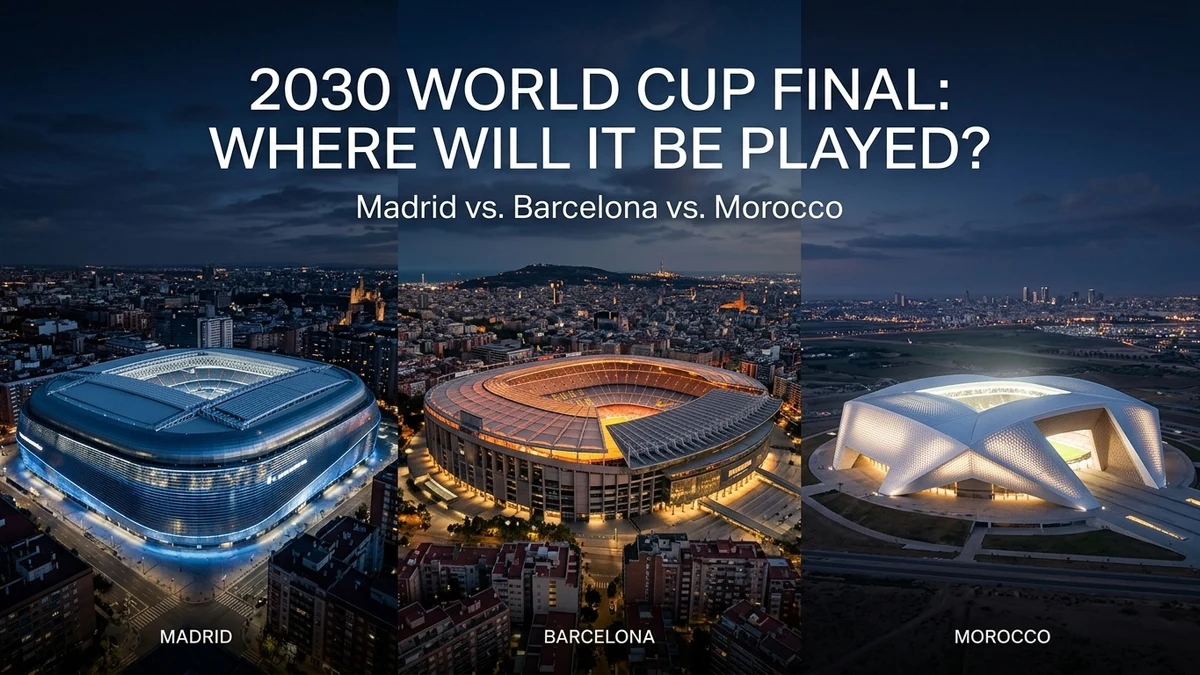
FIFA has not chosen a stadium for the 2030 World Cup final. But the race has taken shape: Spain is pushing its two biggest stadiums — Madrid's Santiago Bernabéu and Barcelona's Spotify Camp Nou — while Morocco is building the 115,000-seat Grand Stade Hassan II outside Casablanca with the World Cup's biggest match explicitly in mind.
All three are 2030 World Cup venues. None has been awarded the final.
And four years out, they make three very different cases: the Bernabéu is the proven stage, Camp Nou offers enormous capacity in one of football's most famous cities, and Hassan II is being built at a scale no purpose-built football stadium currently matches.
The 2030 World Cup Final Stadium Contenders
| Stadium | Location | Capacity | Status | The Case |
|---|---|---|---|---|
| Santiago Bernabéu | Madrid, Spain | About 83,000 | Open, extensively renovated | Proven venue, Madrid infrastructure, World Cup final history |
| Spotify Camp Nou | Barcelona, Spain | 105,000 planned | Major redevelopment ongoing | Huge capacity, iconic club venue, Barcelona |
| Grand Stade Hassan II | Benslimane, near Casablanca, Morocco | 115,000 planned | Under construction | Largest of the three, purpose-built for 2030, historic African final opportunity |
Those capacities need one important qualifier: the Bernabéu is operating today, while the Camp Nou figure reflects its completed redevelopment and Hassan II's 115,000 seats are the planned capacity of a stadium still being built.
Santiago Bernabéu: The Proven Choice
If FIFA wants the safest answer, Madrid has an obvious argument.
The Santiago Bernabéu has already hosted a World Cup final. Italy beat West Germany there in 1982, and the stadium has since staged European Cup and Champions League finals, major international matches, and decades of Real Madrid's biggest nights.
It is also no longer the same stadium that hosted the 1982 final.
Real Madrid's multiyear renovation transformed the Bernabéu with a retractable roof, retractable pitch system, new exterior, expanded hospitality and year-round event capabilities. Its capacity is roughly 83,000 — smaller than the other two leading contenders, but comfortably within the scale expected of a World Cup final venue.
Then there is Madrid itself.
For FIFA, choosing a final venue is about far more than the number of seats. Hotels, airports, transportation, security, hospitality, broadcast operations, sponsor events and moving tens of thousands of international visitors through a city all matter.
Madrid brings an established global-event infrastructure with relatively little uncertainty attached to it.
Spanish federation president Rafael Louzán has publicly argued that Spain's experience and organizational capacity make it the natural place for the final. That is Spain's position, not FIFA's — but it explains why the Bernabéu remains such a serious candidate.
The argument for the Bernabéu
- It has already hosted a World Cup final.
- The stadium is finished and operating.
- Madrid has mature international-event infrastructure.
- It is one of the most recognizable football venues in the world.
- Spain can make the case without relying on a construction project being completed as planned.
Its biggest weakness may simply be scale. An 83,000-seat Bernabéu would leave tens of thousands of seats on the table compared with a completed Camp Nou or Hassan II.
Camp Nou: Spain's Bigger Option
If Spain wants to compete with Morocco on capacity, Barcelona changes the conversation.
FC Barcelona's redeveloped Spotify Camp Nou is designed to reach approximately 105,000 seats when the project is fully complete. That would make it substantially larger than the Bernabéu and one of the largest football stadiums in Europe.
Camp Nou is already an officially selected 2030 World Cup venue, and Barcelona has the international profile, tourism infrastructure and football history expected of a final city.
The question is the stadium itself.
The reconstruction has been a long, phased process rather than a simple renovation completed years ahead of the tournament. Barcelona received authorization in March 2026 for a phase that increased usable capacity to 62,652, while the full project is intended to eventually reach roughly 105,000.
By 2030, today's construction issues may be ancient history. But until the completed stadium is operating at its intended scale, Camp Nou carries more project uncertainty than Madrid.
There is also an interesting bit of World Cup history here: Camp Nou was one of the major Spanish venues in 1982, but Madrid got the final. Nearly half a century later, Barcelona has a chance to make a different case with a much larger rebuilt stadium.
The argument for Camp Nou
- A planned capacity of roughly 105,000.
- One of the best-known football grounds in the world.
- Barcelona is an established global destination.
- It allows Spain to answer Morocco's capacity argument much more directly than the Bernabéu does.
The obvious question is whether the completed redevelopment ultimately gives FIFA everything it wants from a final venue — on schedule and in operation well before 2030.
Grand Stade Hassan II: Morocco's 115,000-Seat Statement
Then there is the stadium that does not exist yet.
Grand Stade Hassan II is being built in El Mansouria in Benslimane Province, roughly 38 kilometers north of Casablanca. Its planned capacity is 115,000.
If delivered as designed, it would be larger than either Spanish contender and is projected by its designers to become the world's largest football stadium.
This isn't simply a giant bowl built because Morocco needs another stadium.
The final is part of the project's identity.
Architects Oualalou + Choi and Populous say the stadium is being designed to meet FIFA requirements with the ability to host the 2030 World Cup final. Its enormous tent-like roof draws from the Moroccan moussem, a traditional gathering, with an aluminum lattice structure, elevated gardens and a stadium bowl built around the scale of a global showpiece.
And construction is no longer theoretical.
In May 2026, Moroccan officials said the project was about 30% complete after nine months of construction, with completion targeted for the end of 2027. More procurement activity followed during August: tenders included external works, the playing surface and the installation of seating.
That matters because Hassan II's biggest vulnerability is also obvious: unlike the Bernabéu, FIFA cannot evaluate the finished building today.
Morocco still has to deliver it.
The argument for Hassan II
- 115,000 planned seats — the largest capacity of the three.
- Purpose-built with the 2030 World Cup in mind.
- A stadium specifically capable by design of staging the final.
- An opportunity for the biggest match in world football to return to Africa.
- A physical symbol of Morocco's enormous investment in the tournament.
If Casablanca gets the final, it would also be historic. Africa has hosted the World Cup only once, in South Africa in 2010, when Johannesburg's Soccer City staged the final.
A 2030 final in Morocco would be only the second World Cup final played on the African continent.
Why the Final Has Become Spain vs. Morocco
Portugal is a primary 2030 host too, but the public race for the final has centered on Spain and Morocco.
That's partly stadium capacity, partly infrastructure and partly symbolism.
Spain enters the discussion with something Morocco cannot build before 2030: a long history of staging the biggest events in European football. Madrid and Barcelona are established global cities, and both stadium candidates belong to clubs with enormous international profiles.
Morocco is countering with scale.
Grand Stade Hassan II isn't an attempt to match the Bernabéu. It is an attempt to build something larger and newer than anything Spain can offer, surrounded by a broader infrastructure push that includes rail, airport, road and hotel development.
There is also a larger question hanging over a World Cup spread across six countries and three continents: what should the centenary final symbolize?
Uruguay gets the tournament's historical beginning. Montevideo will stage one of the three South American centenary matches in recognition of the first World Cup in 1930.
The final could then tell a different story.
Putting it in Spain would give the showcase match to the European half of the primary hosting partnership. Putting it in Morocco would make the centenary edition the first World Cup whose defining bookends stretch from South America at the beginning to Africa at the end.
That's compelling symbolism.
It is not evidence that FIFA will choose Morocco.
What Has FIFA Actually Confirmed?
This distinction matters because there is already plenty of speculation surrounding the final.
Confirmed
Morocco, Portugal and Spain are the primary hosts of the 2030 World Cup.
Uruguay, Argentina and Paraguay will each stage one centenary celebration match in South America.
All six host countries qualify automatically.
FIFA's published tournament calendar has the final scheduled for Sunday, July 21, 2030.
The Santiago Bernabéu, Spotify Camp Nou and Grand Stade Hassan II are part of the 2030 host-venue plan.
Not confirmed
FIFA has not announced which stadium will host the final.
It has not officially declared Bernabéu, Camp Nou and Hassan II a three-stadium final shortlist.
And FIFA has not published the complete match-by-match stadium allocation for the tournament.
So when Spain promotes Madrid or Barcelona, or Morocco makes the case for Hassan II, those should be understood as competing positions — not a decision from FIFA.
When Will FIFA Choose the 2030 World Cup Final Stadium?
There is no publicly confirmed FIFA date for announcing the final venue.
That means any precise claim that FIFA will choose it in a particular month should be treated cautiously unless FIFA announces that timetable itself.
The 2026 World Cup offers some precedent, but not a schedule FIFA is required to repeat: FIFA announced the complete 2026 match allocation, including the New York/New Jersey final, in February 2024 — more than two years before the tournament.
For 2030, FIFA still has significant venue and scheduling work ahead.
Grand Stade Hassan II is scheduled to be completed well before the tournament, Camp Nou's redevelopment must reach its intended final state, and FIFA will eventually have to allocate more than 100 matches across an unusually complicated six-country event.
The final decision could come long before 2030. The date has not.
So Which Stadium Is the Favorite?
There isn't an official favorite.
But the three candidates offer a useful way to think about what FIFA will eventually be deciding.
If proven infrastructure is the priority, the Bernabéu has the cleanest case. It is open, rebuilt, experienced and located in a capital accustomed to major international events.
If Spain wants maximum capacity, Camp Nou is its strongest answer. A completed 105,000-seat stadium narrows most of Hassan II's size advantage while keeping the match in one of Europe's most recognizable football cities.
If capacity, spectacle and centenary symbolism carry the most weight, Hassan II has a case neither Spanish venue can replicate. A 115,000-seat new stadium hosting Africa's second World Cup final would become one of the defining images of the entire tournament.
The biggest variable is time.
By 2028 or 2029, this debate won't be about renderings and construction schedules. FIFA will be able to compare three actual stadiums.
And that may be when the race really starts.
The Bigger 2030 Picture
Where the final lands is only one of the unusual questions surrounding 2030.
The tournament is currently scheduled for 48 teams and 104 matches, with three centenary matches in South America before the competition continues across Morocco, Portugal and Spain. FIFA is also studying a separate proposal to expand the one-off centenary edition to 64 teams, although no expansion has been approved.
That leaves several major pieces of 2030 still taking shape: the final venue, full stadium allocations, qualifying, the draw — and potentially even the size of the tournament itself.
Think you know what the 2030 World Cup will look like? Build your projected field, draw and bracket in the MockSlate Tournament Builder.
Final-venue status, capacities and construction information reflect official FIFA information, club/project sources and credible reporting available as of September 4, 2026. FIFA has not selected or announced the 2030 World Cup final venue. This page will be updated when that changes.
MockSlate is an independent fan tool and is not affiliated with, sponsored by, or endorsed by FIFA, any national federation, club or stadium. Names are used for identification purposes only.
FAQ
Where will the 2030 World Cup Final be played?
FIFA has not announced the stadium. Spain's Santiago Bernabéu and Spotify Camp Nou and Morocco's Grand Stade Hassan II are the leading venues being discussed for the final, but FIFA has not publicly designated an official three-stadium shortlist.
Has FIFA chosen the 2030 World Cup Final stadium?
No. FIFA has confirmed the 2030 hosts and the tournament dates, but the final venue has not been announced.
Could Morocco host the 2030 World Cup Final?
Yes. Morocco is building the 115,000-seat Grand Stade Hassan II near Casablanca, and the stadium has been designed to meet FIFA requirements with the ability to stage a World Cup final. FIFA has not awarded it the match.
How many people will Grand Stade Hassan II hold?
The planned capacity is 115,000. The stadium is under construction in Benslimane Province near Casablanca and Moroccan officials have targeted completion by the end of 2027.
Could the Santiago Bernabéu host the 2030 World Cup Final?
Yes. The Bernabéu is a 2030 World Cup venue and has already hosted a World Cup final, in 1982. Spain is publicly pushing its case for the 2030 final, but FIFA has not made a decision.
Could Camp Nou host the 2030 World Cup Final?
Yes. Spotify Camp Nou is a 2030 World Cup venue and is being redeveloped to a planned capacity of about 105,000. It is one of Spain's leading options for the final, but no final venue has been selected.
When is the 2030 World Cup Final?
FIFA currently lists the 2030 World Cup final for Sunday, July 21, 2030.
Related team pages
Build your own mock schedule
Now put it into practice — place every game into a broadcast-accurate slot and see the whole season take shape.
Open the 2030 Tournament Builder →