Who Has to Give Up a Home Game for International Football? The Rules, Explained
Updated: July 27, 2026

Every NFL international game is a home game taken from somebody. Through 2025, 24 different franchises have been the designated "home" team abroad — led by Jacksonville, twelve seasons running — while eight, including the Cowboys, had never given up a single one. That changes this fall: the 2026 slate takes Dallas, Detroit, and Washington off the never-paid list in the same season. Three rules decide who pays: the conference rotation, the every-eight-years guarantee, and Jacksonville's standing London deal.
Here's how the machine works, who it has actually charged, and the vote this spring that changed it.
The three rules
Rule one: the ninth home game funds the trip. Since the schedule went to 17 games in 2021, the two conferences alternate an unequal split — one conference gets nine home games and eight road games, the other the reverse, flipping every year. The international slate is drawn almost entirely from the conference holding the ninth home game. The logic is straightforward: a team with nine home dates can surrender one and still keep the eight its season-ticket holders expect. AFC teams pay in odd years, NFC teams in even years.
Rule two: everyone plays abroad eventually. The league guarantees every franchise plays internationally at least once every eight years. Note the wording — plays, not hosts. Being the traveling road team ticks the box without costing a home date, which is how some franchises have satisfied the requirement for two decades without ever surrendering anything.
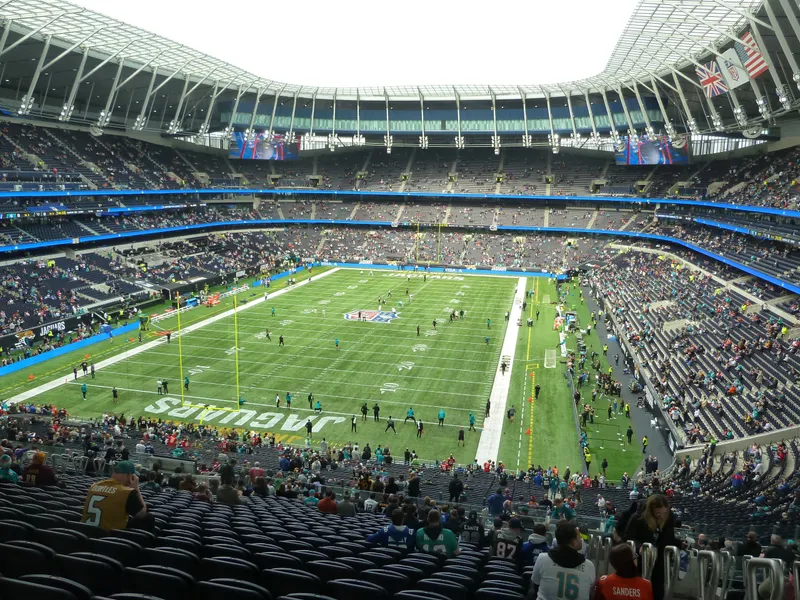
Rule three: Jacksonville always goes. The Jaguars have a standing agreement with Wembley Stadium that operates outside the conference rotation. In 2026 that arrangement is literally structural: the league scheduled eight international games of its own, and Jacksonville's Wembley game is the ninth — an add-on that required separate approval from the players' union because it pushed past the collectively bargained limit.
What the ledger actually says
Here's who has actually paid, 2002 through 2025 — 62 international games, each one a surrendered home date:
| Designated "home" team abroad | Games given up |
|---|---|
| Jacksonville | 12 |
| Buffalo | 7 |
| Las Vegas | 5 |
| Miami | 4 |
| Tampa Bay | 4 |
| Rams | 4 |
| Chargers | 3 |
| Cardinals, Falcons, Browns, Chiefs, Vikings, Saints | 2 each |
| Eleven others | 1 each |
Buffalo's seven includes all six Toronto Series games (2008–2013).
Jacksonville's twelve isn't just the most — it's every single international-era season since 2013, excluding only 2020, when nobody went anywhere. Twelve seasons, twelve London home games, and 2026 extends the run to thirteen straight with two London home dates this time: Houston at Wembley in Week 6, plus a second game at Tottenham. By New Year's, Jacksonville's total will be fourteen — double anyone else's.
Once the rotation took full effect, the designated home teams by year:
- 2022 — Arizona, Green Bay, New Orleans, and Tampa Bay — all NFC — plus Jacksonville.
- 2023 — Buffalo, Kansas City, New England, Tennessee — all AFC — plus Jacksonville.
- 2024 — Carolina, Chicago, Minnesota, Philadelphia — all NFC — plus Jacksonville.
- 2025 — Cleveland, Indianapolis, the Chargers, Miami, the Jets, Pittsburgh — all AFC — plus Jacksonville.
- 2026 — the Rams (Melbourne), Cowboys (Rio), Saints (Paris), Falcons (Madrid), Lions (Munich), 49ers (Mexico City), and Commanders (London) — all NFC — plus Jacksonville, twice.
The eight who had never paid — until now
Through the 2025 season, eight franchises had never once been the designated home team abroad: Baltimore, Dallas, Denver, Detroit, Houston, the Giants, Seattle, and Washington.
Every one of them has played internationally — as the visiting team, keeping all their home dates intact. That's the eight-year guarantee doing exactly what its wording allows: Dallas has been to London and Mexico City, the Giants have crossed the Atlantic repeatedly, and none of it cost their fans a Sunday.
There's no single reason the same names kept dodging the bill, but the list is suggestive. It's heavy on the league's biggest stadium revenues and most protected franchises. When the league needed volunteers, these weren't the teams volunteering — and when the rotation formalized, the ninth-home-game rule still only reaches into each conference every other year, which left room for some teams to keep missing the draw.
In 2026, three of the eight pay at once. It's the NFC's ninth-home-game year, and the draw finally caught them:
- Dallas surrenders a home game to Rio de Janeiro — the first NFL game at the Maracanã — hosting Baltimore on September 27.
- Detroit surrenders one to Munich, hosting New England on November 15.
- Washington surrenders one to London, at Tottenham Hotspur Stadium.
After this season the never-paid list is down to five: Baltimore, Denver, Houston, the Giants, and Seattle — and two of those five are in 2026's international games anyway, as visitors: the Ravens in Rio and the Texans at Wembley.
How the rules got here
The current system is the third attempt at solving the same problem: nobody wants to give up a home game.
The volunteer era (2005–2013). One or two games a year, staffed by whoever would go. The series opened with Miami "hosting" the Giants at Wembley in 2007 — the Dolphins were the volunteer for the very first one — and in practice the volunteers were teams with attendance problems, relocation questions, or something to gain. This is when Jacksonville's London identity began, explicitly framed by team and league officials as strengthening the franchise's position in Jacksonville.
The incentive era (2014–2020). In 2014 the owners attached a carrot: surrender a home game to the International Series and your stadium became eligible to host a Super Bowl. It was a lottery ticket, not a purchase — and the two teams that bought in tell both endings of the story. Miami gave up Wembley home games in 2015 and 2017, and in February 2020 Hard Rock Stadium hosted Super Bowl LIV. The incentive worked exactly as designed, once. Kansas City gave up its own Wembley home game in 2015 for the same eligibility — and has never hosted a Super Bowl. Same price, no payout.
The rotation era (2021–present). The 17th game made the whole problem solvable. An unequal home/road split already existed, so the league attached the international slate to the conference holding the surplus. No more volunteering, no more horse-trading — your conference's year comes up, and the league picks from your ranks.
What changed this spring
At the league meeting in May 2026, the owners went further: they approved a path to ten international games in 2027 and — the bigger move — voted to strip teams of the ability to protect any home game from international play.
Until now, teams could shield specific matchups: the rivalry game, the marquee home date, the game season-ticket renewals are sold on. That protection is gone. When your conference's year comes up, any home game on your schedule can be the one that boards a plane — which means the eight-team never-paid list is now living on borrowed time. The machinery that let the same franchises keep missing the draw has been deliberately dismantled, one rule at a time, for twenty years. This was the last piece.
Why schedule builders should care
The international slate is the first thing on the real schedule, and it should be the first thing on yours. Those games are announced months before the full schedule, and each one fixes far more than one line on the grid: the designated home team loses a date, both teams need travel-adjusted surrounding weeks, and the league tries to place byes after the long trips.
If you're building a 2027 mock, the rules above are your constraints: draw the league-run games from the nine-home-game conference, send Jacksonville to Wembley, and don't hand a London date to a team that just had one — the eight-year guarantee is about spreading the load. Our mock schedule builder enforces the structural rules of the NFL calendar so you can test your slate against the same limits the league works under, and see in May how close you got.
Somebody has to give up a home game. As of this spring, it can be anybody.
Game data from MockSlate's NFL slot history dataset, built from nflverse/nfldata. League policy details verified against NFL Football Operations and reporting from ESPN and CBS Sports, July 2026.
MockSlate is an independent fan tool and is not affiliated with, sponsored by, or endorsed by the National Football League or any NFL team. Team names are used for identification purposes only.
Related team pages
Build your own mock schedule
Now put it into practice — place every game into a broadcast-accurate window and see the whole season take shape.
Open the Mock Schedule Builder →